Batumi: the complete travel guide to Georgia's Black Sea city
Is Batumi worth visiting?
Yes, as a 2–3 day stop. Batumi combines a seven-kilometre seafront Boulevard, a pebble beach with swimmable water from June to September, a botanical garden and Adjarian food you will not find elsewhere in Georgia. It is best in summer, and works as a base for Roman ruins, waterfalls and mountain villages within 90 minutes.
Batumi is the capital of the Adjara region and Georgia’s subtropical Black Sea city: a pebble-beach resort with a seven-kilometre seafront Boulevard, casino towers, Art Nouveau streets and the mountains of Adjara rising right behind it.
| What it is | Black Sea resort city in Adjara, close to the Turkish border |
| Best time | June–September for the sea; September is arguably the best month |
| Days needed | 2–3 days for the city, 3–5 with the region |
| Beach | Grey pebble, not sand |
| Getting there | Batumi airport (BUS), or about 4.5–6 hours from Tbilisi |
| Cost | Around ₾80–150/day mid-range, higher in summer |
What to see and do in Batumi
The Boulevard. The seven-kilometre seafront promenade is the spine of the city: fountains, sculptures, cafes, playgrounds, bike and quadricycle rental, and the Alphabetic Tower. It fills with evening strollers all year and turns into a carnival in summer. The Ali and Nino moving sculpture and the musical fountain show are the two evening stops most visitors plan around.
The old Boulevard runs along the central beach for about 2 km from the port, and the New Boulevard continues roughly 5 km north, where the Ferris wheel and the light-sculpture zone stand. The Chacha Tower is a near neighbour of the Alphabetic Tower. The two lovers of the Ali and Nino sculpture converge and part every ten minutes. The fountain show runs on summer evenings and is free, but arrive about 20 minutes early to find space. Bike stations and quadricycle kiosks are spaced along the whole length, and the pedal carts are a hit with children.
The old town. Around Piazza Square and the pedestrian streets behind it, you find Art Nouveau facades, churches next to mosques and an ornate opera house. Batumi was under Ottoman rule from the 17th century until 1878, which is why it feels different from the rest of Georgia. The Italianate square faces the sea, and the bars and restaurants around it stay open late, with live music on summer evenings. A guided walking tour of the Boulevard and Old Town takes two to three hours and helps you read the Ottoman, Soviet and contemporary layers.
The beach. Batumi has no sand. The central beach is crowded but convenient, while the New Boulevard, Green Cape and Kvariati have cleaner water. Sunbeds cost around 15–30 GEL per set per day. The Batumi beaches guide compares the stretches, and for sand you need to go north to Ureki.
On the central beach you find showers at regular intervals, lifeguards in peak season and public toilets that charge about 1 GEL. Banana boats, parasailing and jet skis cost 150–300 GEL per activity. Water quality is acceptable but not pristine, because of the nearby port and stormwater runoff, so avoid swimming near the port or right after heavy rain. Green Cape, 9 km north, is rockier but more scenic: a marshrutka or taxi takes about 20 minutes, and facilities are minimal, so bring supplies. Kvariati, between Batumi and Gonio, is a small resort village with a quieter beach that Turkish day-trippers like. To get away from the crowds altogether, a private Black Sea boat trip shows you the coast from the water.
Batumi Botanical Garden. Founded in 1912, it covers more than 110 hectares on a headland 9 km north of the centre, with sections dedicated to Japan, the Himalayas, Mexico, Australia and more. Allow 2–3 hours, or 3–4 with children. The easiest route is to take a taxi to the upper entrance, walk downhill through the sections to the lower exit at the seafront, then order a taxi back. There are benches, fountains and picnic spots throughout, and a modest cafe at the entrance. If you prefer to have it organised, a tour of the Botanical Garden, Petra fortress and the Miniatures Park bundles the sights into one outing.
Gonio fortress. Twelve kilometres south, the Roman fort of Apsaros dates from the 1st century AD. Stretches of its wall still stand to 5 metres. Read the Gonio beach and fortress guide before you go. Allow about 1.5 hours: a small archaeological museum shows Roman coins and amphorae, and excavated baths are visible inside the walls. It pairs well with a swim, and the Sarpi border beach is a little further south.
When to go
The sea is swimmable from June to September and peaks at 24–26°C in August. Air temperatures reach 27–33°C in July and August, with high humidity. September gives you warm water, thinner crowds and lower prices. May and October are possible for committed swimmers. From November to April the water is cold, the city is grey and rainy, and many businesses close, although the architecture, food and casinos carry on.
Batumi is one of the wettest places in Georgia, with more than 2,500 mm of rain a year, so pack a waterproof jacket whatever the month. The best time to visit Georgia guide explains the seasons across the country.
How many days do you need?
Two to three days covers the Boulevard, old town, botanical garden and a beach afternoon. Add two or three day trips and you reach four to five days. Families often stay four to seven. Batumi works best as a stop rather than a week-long beach holiday, and most trips of a week or more in Georgia should combine it with Tbilisi. The Tbilisi vs Batumi guide helps you split your time: Tbilisi wins for culture and food, Batumi wins in July and August.
Where to stay
For a first visit, stay in Batumi itself, where the sights, restaurants and transport are in one place.
- Waterfront towers are the most comfortable, with sea views and full amenities, but noisy in summer. Peak doubles start around $200–280 a night. The Hilton, the Radisson Blu on the Boulevard and the glass-towered Euphoria, which has a casino and a rooftop terrace, are the best-known names.
- The old town has smaller, more characterful boutique hotels and guesthouses, typically 30–50% cheaper, about a 10–15 minute walk from the beach. Family-run places around the Piazza district often include breakfast and will arrange transport for you.
- Mid-range hotels run about 100–200 GEL a night in shoulder season, roughly double in July–August. Along the central Boulevard they sit 40–60% below the five-star towers, but many were built in the 2010–2015 boom and are showing their age, so read recent reviews. A street or two back from the sea, you give up the view and often get larger rooms.
- Hostels start around 25–40 GEL for a dorm bed in shoulder season and 50–70 GEL in July–August. Private guesthouse rooms cost about 80–150 GEL with a modest breakfast.
- Quieter bases: Gonio, 12 km south, and Kobuleti, 30 km north, are calmer and cheaper, and suit families. Kobuleti guesthouses with full board cost 60–100 GEL per person in shoulder season, and marshrutkas connect it to Batumi in about 40 minutes.
Book waterfront hotels six to eight weeks ahead for July–August, and expect rates to triple at the better ones during the first two weeks of August, when Georgian holidaymakers fill the city. Guesthouses outside Batumi usually want cash, so carry lari. For a trip of five days or more, consider splitting your nights between Batumi, a Khulo guesthouse (about 60–80 GEL per person with dinner and breakfast, booked by phone) and a final night on the coast. The where to stay in Adjara guide compares districts and budgets in detail.
What to eat
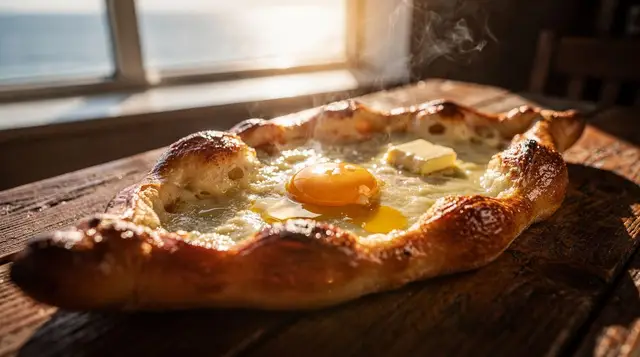
Batumi’s signature dish is Adjaruli khachapuri: a boat-shaped bread filled with melted sulguni, a raw egg and butter, stirred at the table. Expect to pay about 15–25 GEL for one. The version made in the older streets, or better still in the mountain villages, beats the seafront strip. Other local foods include kaymaghi clotted cream, Black Sea mullet, and hamsi (anchovy) in late autumn and winter. The central market, open in the morning, is the best place to understand it all: mountain producers bring kaymaghi, which locals eat with bread and honey at breakfast, along with beans, fresh fish, churchkhela and bread from tone bakeries. The Ottoman influence shows in the pastry shops, where pakhlava (baklava) with local walnuts and honey sits next to kadaif and pelamushi.
For the real version of the khachapuri, walk away from the seafront to the older neighbourhoods around Marjanishvili, the Piazza and the lower market district. Mullet is at its best in summer and early autumn, grilled simply with herbs, and the fish bazaar is busiest on weekday mornings. On the Boulevard, a beach-cafe lunch costs about 25–60 GEL per person and a dinner 40–150 GEL or more. In the mountains, try borano, melted butter and cheese eaten with bread, in autumn or winter. Our Adjaran cuisine guide covers the dishes and where to find them.
Nightlife
Batumi nightlife is seasonal and beachside: open-air clubs and beach bars on the Boulevard from mid-June to mid-September, peaking in July and August, plus rooftop cocktail bars. The casinos run year-round, welcome non-players, and expect smart casual dress. Cocktails cost around 20–40 GEL and beer 5–10 GEL. It is a holiday scene, not a serious techno scene, so Tbilisi is the better choice for that. See the Batumi nightlife guide for venues.
Batumi with kids
Batumi is arguably the best family base in Georgia. The city is flat and compact, playgrounds line the Boulevard, and there is an aquarium and a dolphinarium. The Argo cable car climbs to Anuria Hill at 256 metres, and Tsitsinatela, Georgia’s largest amusement park, sits 30 minutes north and runs in summer only. The pebbles are hard on small feet, so bring aqua shoes. Late June and early September are the sweet spots. The Batumi with kids guide has a four-day itinerary.
Day trips from Batumi
Mountain Adjara starts within an hour or so of the Boulevard:
- Makhuntseti waterfall and Queen Tamar’s Bridge, 30 km east: a 20-metre waterfall and a 12th-century stone arch bridge, an easy half day. The two stand within 100 metres of each other, and the base pool is a 200-metre walk from the roadside parking. The upper viewpoint is a steep 15-minute climb.
- Mtirala National Park, 25 km east: wet subtropical rainforest, waterfalls and guesthouse lunches. A 7-km visitor-centre trail leads past the waterfall. Leave Batumi around 09:30, walk for about 2 hours, eat at a guesthouse and be back by 16:00.
- Khulo and Goderdzi Pass, 90 km: the main mountain town, a cable car and an alpine pass at 2,025 metres, in a full day. Leave at 08:30 and expect to return around 19:00. Goderdzi has a small ski resort in January–March.
- Machakhela: a valley of old stone arch bridges and traditional houses, with more than 15 bridges still in use. It suits a half day and combines well with Gonio.
- Gonio and Sarpi: Roman walls and a quieter beach, served by regular marshrutkas.
- Kobuleti: a long resort beach and the Kolkheti wetlands for bird-watching, 30 km north.
Organised minibus tours cost about 40–90 GEL per person, and a taxi to Makhuntseti and back costs 60–100 GEL for the vehicle. Marshrutka fares are 2–8 GEL, but Khulo and Machakhela are hard to reach independently, so a tour or a taxi with a waiting driver is the practical choice there. Pack a waterproof jacket and light layers, since Batumi can be 30°C while Goderdzi Pass is 10°C. Mountain mosque villages call for covered shoulders and knees.
If you only have time for one, choose Makhuntseti. The day trips from Batumi guide has timings, and the best tours in Adjara lists organised options if you would rather not drive. The beach town of Kobuleti also has its own guide.
Getting there and getting around
Batumi has an international airport (BUS) with flights from Istanbul, Tel Aviv, Warsaw and several other cities, as well as from Tbilisi, a flight of about 45 minutes. The airport is about 15 minutes from the centre. Tbilisi is roughly 380 km away: about 4.5 hours by expressway, or 5–6 hours by train. The summer-only sleeper train has four-berth compartments and an early-morning arrival, which makes it a comfortable way to link the two cities, and you should book it a few days ahead.
In the city, the Boulevard and centre are walkable. Taxis are cheap at 5–15 GEL for most journeys, and Bolt and Yandex both work here, even late at night. Marshrutkas connect Batumi’s central bus station to Gonio, Kobuleti and the highland towns, and shared taxis for Khulo leave from the main market, Bazroba. Allow a full day for the round trip to Khulo, and stay overnight if you can. You do not need a car in the city, but one helps for the mountain valleys. The Sarpi border with Turkey is about 20 km south, so bring your passport if you go near it.
Frequently asked questions about Batumi
Is Batumi good for a beach holiday?
It is better regarded as a subtropical city with a beach, not a classic beach resort. The beach is pebble, and the central stretch is crowded, but the water is warm from June to September. For calmer or sandier options, look at Kobuleti or Ureki.
How many days should I spend in Batumi?
Two to three days for the city itself. Add more if you want to include day trips into mountain Adjara.
Is Batumi expensive?
It is cheap by European standards, but pricier than most Georgian cities in summer. Peak August hotel rates can match or exceed Tbilisi’s. Batumi in winter is genuinely cheap.
Is Batumi worth visiting in winter?
Mostly not on a first trip: it is grey and wet, and many restaurants and hotels close from November to March. The casinos stay open, and the food and architecture still work.
Can I visit Turkey from Batumi?
Yes, via the Sarpi border, and Batumi is the best base for combining Georgia with northeast Turkey. Most Western passport holders do not need a Turkish visa, and Trabzon is about three hours south by road.
Is Batumi safe?
Yes, it is generally safe, including at night, though there are some tourist-targeted scams around the casinos and seafront.
Adjara & Batumi tours on GetYourGuide
Verified deep-linked GetYourGuide tours. Book through these links and we earn a small commission at no cost to you.
GetYourGuide provides no product photo for this activity — the image illustrates the destination, not the tour itself.